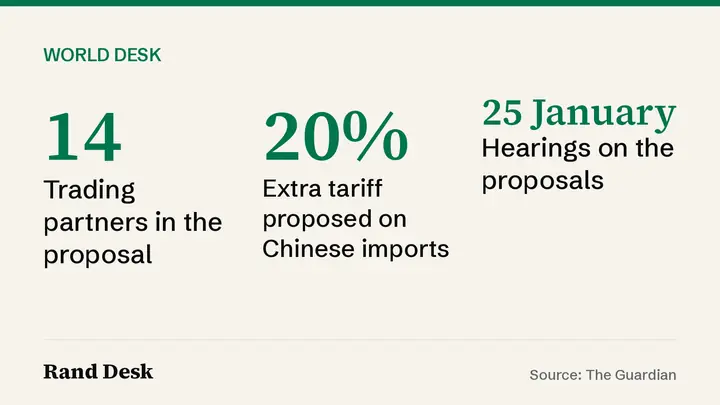
The US trade representative’s office proposed fresh tariffs on 14 economies on Wednesday, with China and the European Union among them, The Guardian reported. South Africa is not on the list.
The Guardian said the plan adds 20% to the tax on Chinese imports, taking the total to about 40%. Eleven of the others are in Asia: Japan, South Korea, India, Taiwan, Singapore, Malaysia, Thailand, Vietnam, Cambodia, Indonesia and Bangladesh. Switzerland is the other, and the EU is counted as one partner.
The tariffs could take effect in January at the earliest, though the White House gave no timeline. It will hold hearings on the proposals, and on its investigation into unfair trade practices, on 25 January.
The legal basis is new. The US supreme court struck down the Liberation Day tariffs in February, because the administration had used the wrong emergency law. The White House has turned to section 301 of the 1974 Trade Act. That law allows retaliation after a formal investigation into unfair practices, and the February ruling left the president’s wider tariff powers intact.
A first batch under section 301 came in July, covering more than 80 countries, among them the UK, Mexico and Canada. The White House said they had not enforced bans on forced labour. The Guardian reported that a challenge to those tariffs is waiting for a decision at the court of international trade.
Jamieson Greer, the US trade representative, said in a statement quoted by The Guardian that partners had built “market distorting practices” into their economies, and that the president proposed to act against them.
At home, the Guardian said tariffs have proven unpopular with US voters, who gave Democrats control of Congress in the midterm elections. It added that the Yale Budget Lab estimates tariffs in force have added about US$900 in costs for each US household. US consumer prices rose at an annualised 3.8% in October, according to the Bureau of Economic Analysis, the highest since May.
For South Africa, the direct effect is limited for now. The country is not a named partner, and its trade with the US faces a separate change: the US says it will end South Africa’s Agoa benefits on 1 January 2027. President Cyril Ramaphosa has said the government sees the exit as a chance to find new export markets.
The next step is the US trade representative’s hearing on 25 January, after which the office will decide whether to go ahead with the tariffs and from what date.