Companies pay the Companies and Intellectual Property Commission (CIPC) R100 to R3,000 to file their annual return on time, with a higher fee if late.
The CIPC says all companies, including external companies, and all close corporations must file every year. Returns can only be filed electronically, through its eServices or BizPortal. An annual return goes to the CIPC, and SARS tax returns are a separate filing (see our guides to SARS deadlines through the tax year and provisional tax).
When is the return due?
A company files in its anniversary month, which follows its registration date. The CIPC gives the example of a company registered on 26 June 2009, whose first return fell due in June 2010 and then every June after that.
According to the CIPC, a company has 30 business days from the date its return becomes due before it counts as non-compliant with the Companies Act. Close corporations work on a different clock: from the first day of the anniversary month until the end of the month after it.
What does the return cost?
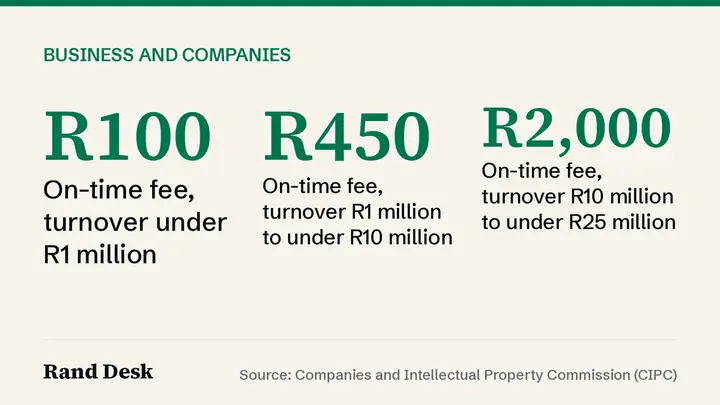
The fee depends on the company’s annual turnover. The fee table under the Companies Act, 2008 is below, with the fee for filing within 30 business days of the anniversary date and the higher fee after that.
Filed on timeFiled late
Source: CIPC, Frequently Asked Questions: Annual Returns v5.0, Companies Act 2008 fee table. Chart: Rand Desk
| Annual turnover | On time | Late |
|---|---|---|
| Under R1 million | R100 | R150 |
| R1 million to under R10 million | R450 | R600 |
| R10 million to under R25 million | R2,000 | R2,500 |
| R25 million or more | R3,000 | R4,000 |
Close corporations pay R100 on time up to R50 million turnover, and R4,000 from R50 million, with a R150 penalty for each late return, according to the same FAQ. The CIPC says its system works out the fee at the end of the filing, and that the fee cannot be waived or paid in instalments. A filing that arrives without the fee is invalid and has to be filed again.
Lateness adds R50 under R1 million, R150 from R1 million to R10 million, R500 in the R10 million to R25 million band and R1,000 above R25 million.
What must go in with it?
A company must also file, the CIPC says, its latest beneficial ownership declaration, its audited financial statements or its financial accountability supplement, and a compliance checklist. If the CIPC does not hold the latest beneficial ownership declaration, the filing system redirects the filer to that service first.
Beneficial ownership means naming the natural person behind the company, whether the ownership is direct, indirect or through a trust. In a presentation dated 30 June 2026 the CIPC said the information must be submitted with the annual return and updated whenever it changes.
Do dormant companies have to file?
Yes. The CIPC says the Companies Act and the Close Corporations Act make no distinction between an active and an inactive company, so a dormant company must still file and pay the fee for each year.
What happens if the return is not filed?
A missing return reads to the CIPC as a sign that the company is not doing business. It says deregistration is triggered automatically once two or more successive returns are outstanding.
While a company is in deregistration, the CIPC says, government departments, SARS and banks may refuse to deal with it until the returns are filed. A company that has been finally deregistered ceases to exist as a legal entity and must apply for reinstatement before it can trade again. The CIPC’s FAQ lists a R200 fee for the reinstatement application (form CoR40.5), and the returns that are outstanding still have to be filed. The directors in office when the company was deregistered can still be held liable for what the company did while it traded.
How we worked it out
The fees are the CIPC’s prescribed amounts for each turnover band, and the late-filing differences are the late fee minus the on-time fee. Check your own turnover band against the table, then confirm the amount on the CIPC’s filing screen, which calculates it for you.
The next step for a company is to check the registered email address at the CIPC and file in its anniversary month.