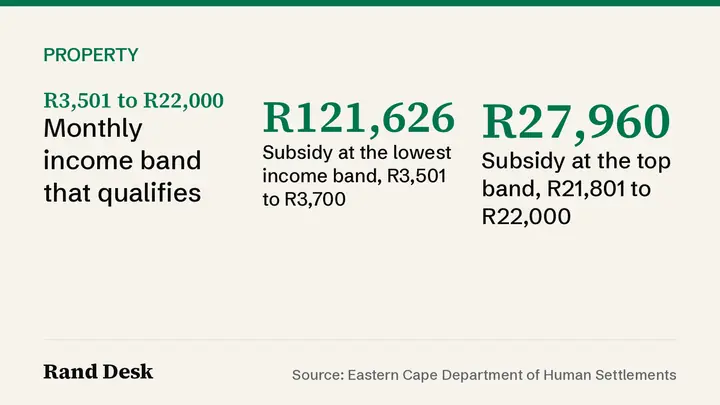
The government’s FLISP subsidy, now called First Home Finance, pays R27,960 to R121,626 towards a first home, depending on income, says Nedbank’s brochure. For a buyer on about R9,000 a month with a R300,000 bond, the R93,526 subsidy cuts the repayment by R950 a month.
The Eastern Cape department says the national Department of Human Settlements developed the scheme for citizens and legal permanent residents earning R3,501 to R22,000 a month, too much for a free state house and too little to get a bond easily.
Who qualifies
The Eastern Cape department lists five conditions. The buyer must:
- be a South African citizen with a valid ID, or a permanent resident with a valid permit;
- be over 18 and able to sign a contract;
- never have received a government housing subsidy before;
- hold an approval in principle for a home loan from an accredited lender;
- be a first-time buyer earning R3,501 to R22,000 a month.
Nedbank’s brochure says the income can be a single or a joint income. It also says there is no cap on the size of the bond. Nedbank’s brochure says a buyer paying cash does not qualify, because the subsidy is tied to a bank loan.
How much it pays
The subsidy falls as income rises. Nedbank’s table has 91 steps, each covering R200 to R400 of income, and the subsidy drops by about R1,040 a step on average. It starts at R121,626 for income of R3,501 to R3,700 and ends at R27,960 for R21,801 to R22,000.
Source: Nedbank FLISP brochure, subsidy bands listed by the top of each income band. The Eastern Cape Department of Human Settlements gives a range of R30,001 to R130,505. Chart: Rand Desk
The Eastern Cape department gives a different range: R30,001 to R130,505. We could not find a current table on a national government page that opens, so we do not know which figures the Department of Human Settlements applies today. The two sources do agree on one number: at about R9,000 a month the subsidy is R93,526. Anyone applying should ask the bank or the provincial department for the amount that applies to their income.
What it does to a bond
The Eastern Cape department gives two ways the subsidy can be used. It can reduce the loan, paid into the bond account. Or it can top up the gap between what the bank will lend and the price of the home, paid to the transfer attorneys.
The department’s own example is a buyer on R9,000 a month whom the bank approves for R300,000. With the subsidy of R93,526 the eventual loan is R206,474.
At prime of 10.75%, the rate the Reserve Bank’s series showed on 25 November 2026, the sums for a 20-year loan are:
| Loan | Monthly repayment | Interest over 20 years | |
|---|---|---|---|
| Without the subsidy | R300,000 | R3,046 | about R431,000 |
| With the subsidy | R206,474 | R2,096 | about R297,000 |
The buyer saves R950 a month and about R134,000 in interest over the life of the loan. The example is a worked illustration, not an average. The same sums for any other loan size are in our table of home loan repayments, and the bond calculator at randdesk.co.za/bond-calculator/ takes your own figures.
How to apply
Nedbank’s brochure says the bank’s home loan consultant submits the subsidy application with the bond application. A buyer can also go to the nearest provincial human settlements department. The Eastern Cape department asks for certified copies of an ID, proof of income, the bank’s approval in principle and the agreement of sale.
If the bank declines the loan, the subsidy cannot be paid. The brochure says an applicant should find out why the bond was declined and fix it before applying again.
Transfer duty and bond registration come on top of the subsidy. They are worked through in our example of transfer duty and bond costs, and the other costs after the deposit are in our list of costs after the deposit.
How we worked it out
We took the department’s example loan of R300,000 and the R93,526 subsidy for a R9,000 income, and worked the repayment on a 20-year term at 10.75%. Use the same formula with your own loan, subsidy and rate, or enter them in the bond calculator. The prime rate comes from the Reserve Bank’s published series, which showed 10.75% on 25 November 2026.