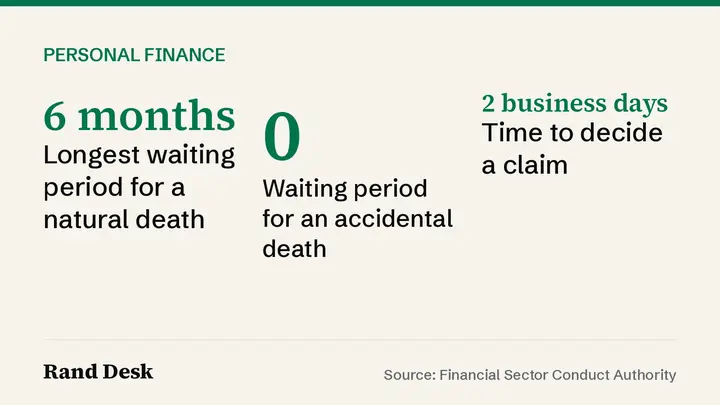
A funeral policy may not impose a waiting period longer than six months for a death from natural causes, according to the Financial Sector Conduct Authority’s policyholder protection rules. For an accident there may be no waiting period at all.
What the rules say about waiting periods
The limit is the shorter of six months or one quarter of the policy’s term, in rule 2A.6.1 of the amended rules, published on 28 September 2018 and in force from 1 October 2018. A 12-month policy could therefore carry a waiting period of three months at most.
Rule 2A.6.2 bars any waiting period for a death resulting from an accident. A renewal cannot start a new waiting period either (rule 2A.6.4).
Moving between insurers is covered too. An insurer may not impose a waiting period if the policyholder had a similar policy with another insurer for at least 31 days before and had finished that policy’s waiting period. If the earlier waiting period had not ended, the new insurer may apply only the part that was left (rules 2A.6.5 and 2A.6.6).
How fast an insurer must decide a claim
Once it has all the documents, the insurer has two business days to decide whether the claim is valid and then to authorise payment, turn it down or tell the claimant it is disputed (rule 2A.8.1). A disputed claim gets a further 14 business days to investigate, decide and pay or repudiate (rule 2A.8.2).
An insurer may not turn a claim down for information it never asked for before the policy began (rule 2A.8.3). A policy may not exclude suicide for longer than 12 months from its start (rule 2A.7.2), and it may not exclude a pre-existing health condition except through the waiting period (rule 2A.7.1).
Missed premiums
For premiums due monthly or more often, the cover stays in force for 15 days after the due date, and the insurer must tell the policyholder of the missed payment within 15 days. If a valid claim arises in that time, the insurer may deduct the unpaid premium from the payout (rules 15A.1 and 17.11.1).
A policy that lapsed because of unpaid premiums and is reinstated cannot carry a new waiting period (rule 2A.9.1).
What to check before you buy
The FSCA’s consumer article lists the checks. Ask the seller to show an FSCA licence. Find out who the insurer is, because funeral policies are often sold and run by third-party administrators. Read the policy summary once it arrives, and keep proof of every premium payment.
The article also says a policy owner has 30 days after receiving the policy to cancel it, and that a claim must be submitted as soon as possible, because a late claim can be refused. A spokesperson for the Ombudsman for Long-term Insurance said in the FSCA’s article that a common complaint is a claim declined because the death fell in the waiting period. The spokesperson advised understanding it, especially when adding a family member later.
Our guide to your rights on Black Friday deals and returns covers other consumer protections, and our UIF explainer covers what the fund pays. A claim that is refused must be explained in writing, and the Ombudsman can be approached if the insurer does not resolve it. The cooling-off period runs for 30 days from the day the policy is received.