A litre of 93 petrol in Gauteng costs R29.87 from 4 November 2026, of which R18.07 is the basic fuel price, the Department of Mineral and Petroleum Resources said.
The Central Energy Fund published the structure on 30 October on the department’s behalf. It lists every part of the price in cents a litre, for the period 4 November to 1 December 2026. The grouping below is ours.
The basic fuel price
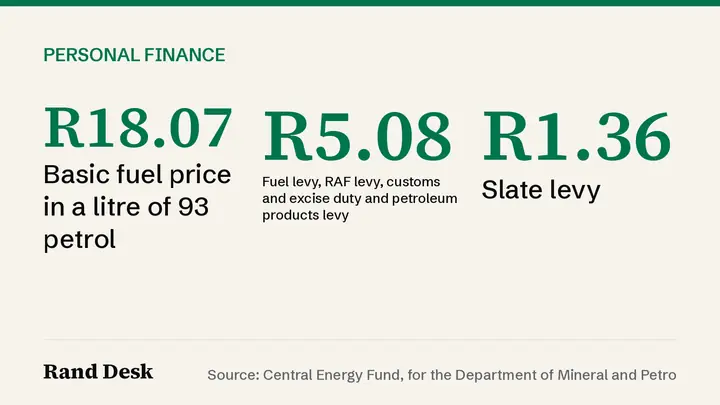
The basic fuel price is what it costs to import a litre of petrol into South Africa. It follows international product prices and the rand/dollar rate, and the department resets it each month. It is R18.07 of the R29.87, or 60.5%.
The department corrects it with a one-month lag. For the period 2 to 29 October, it said fuel was under-recovered by 100.59c a litre on 95 petrol, because international prices and the rand moved against South Africa. The rand averaged 16.5529 to the dollar in that window, against 16.2123 in the one before.
The levies
Four items go to the state: the fuel levy, the Road Accident Fund (RAF) levy, a customs and excise duty and the petroleum products levy. Together they come to R5.08 a litre, or 17.0% of the price.
Source: Central Energy Fund for the Department of Mineral and Petroleum Resources, price structure for 4 November to 1 December 2026; Rand Desk grouping. Chart: Rand Desk
The fuel levy in the structure is R2.79 a litre, after the temporary relief of R1.50 a litre that runs from 4 November to 1 December. The RAF levy is R2.25. Our explainer on how fuel levies are set covers who sets each one, and how the temporary relief works covers when it ends.
The slate levy
The slate levy is R1.36 a litre, or 4.5% of the price. It recovers past under-recoveries, the months when the basic fuel price was set below the cost of the fuel.
The department said the combined petrol and diesel slate balance stood at a negative R15.876 billion at the end of September. Under its self-adjusting mechanism, a slate levy applies whenever the balance is more than R500 million negative. It raised the levy by 48.18c, from 87.66c to 135.84c a litre, from 4 November.
The margins
The dealer’s retail margin is fixed in the structure at R3.20 a litre, or 10.7%. The remaining R2.16 pays the wholesaler’s margin (66.5c), secondary storage (39c), secondary distribution (19.1c) and the Gauteng zone differential (91.1c). Pump rounding takes off 0.2c.
What it comes to on a 50-litre tank
On an illustrative 50-litre tank of 93 at R29.87, the price of R1,493.50 splits as follows, to the nearest cent:
| Part | A litre | A 50-litre tank |
|---|---|---|
| Basic fuel price | R18.07 | R903.67 |
| Fuel levy, RAF levy and duties | R5.08 | R254.17 |
| Dealer retail margin | R3.20 | R160.00 |
| Wholesale, storage, delivery and zone | R2.16 | R107.85 |
| Slate levy | R1.36 | R67.92 |
| Pump rounding | R0.00 | -R0.10 |
How we worked it out
Divide each line in the department’s price structure by 100 to get rand a litre, and multiply by the litres you buy. A 10c move in the basic fuel price changes a 50-litre tank by R5. Our fuel price page at randdesk.co.za/fuel-price shows the current prices.
The structure covers 4 November to 1 December 2026, and the department publishes a new one for the next period.