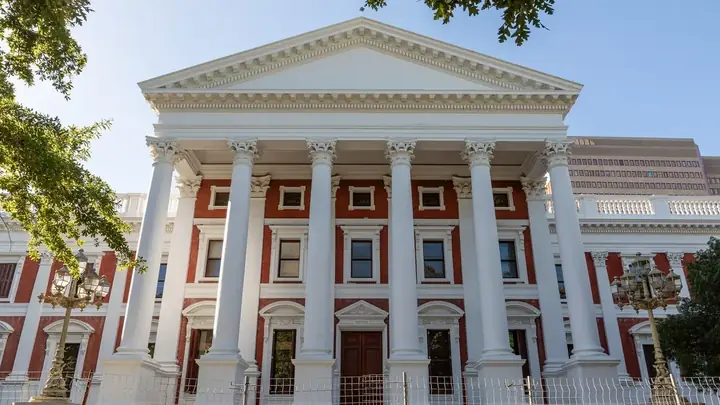
Finance Minister Enoch Godongwana tabled the Medium-Term Budget Policy Statement (MTBPS) on 21 October 2026, eight months after the February Budget. Parliament votes on the money in a fixed order.
What is in the February Budget?
A Parliament press release of 22 July 2025 says the Finance Minister brings a set of budget papers to the House every February. They include the Fiscal Framework, the Division of Revenue Bill and the Appropriation Bill.
The Fiscal Framework sets out revenue targets, economic assumptions, debt levels and overall spending limits. The Division of Revenue Bill shows how money is shared between national, provincial and local government. The Appropriation Bill lists each national department, called a Vote, and the amount it receives.
What does the MTBPS do?
The MTBPS revises the February numbers during the financial year. On 21 October 2026 Finance Minister Enoch Godongwana tabled a Division of Revenue Amendment Bill, an Adjustments Appropriation Bill, a Special Appropriation Bill and a Revised 2026/27 Fiscal Framework. He tabled three tax bills and the 2026/27 Adjusted Estimates of National Expenditure at the same sitting.
The speech also revised the forecasts. Treasury now expects real growth of 1.2% in 2026, down from the 1.6% it projected in February. It raised gross tax revenue for the year by R17.1 billion against the February estimate, and Treasury said the extra revenue let it raise spending by R45.5 billion on the February plan. The Adjustments Appropriation Bill also draws on the contingency reserve.
Source: National Treasury, Medium-Term Budget Policy Statement speech, 21 October 2026. Chart: Rand Desk
How does Parliament vote on the money?
Parliament must consider the budget documents in a set order, the same release says. The Fiscal Framework comes first and must be adopted within 16 days of the Budget being tabled. The Division of Revenue Bill follows, then the Appropriation Bill.
The Standing Committee on Appropriations examines the whole Appropriation Bill. Each Vote also goes to the committee that watches that department, such as health or education. If that committee wants a department’s allocation changed, it has to ask the Standing Committee to recommend the change.
In the National Assembly the Bill passes through three stages: a first reading on its principles, a debate and vote on each Vote, then approval of the full schedule and a second reading. A “no” at first reading rejects the Bill. The National Council of Provinces then considers it.
Can Parliament change the Budget?
Yes. A 2009 law on money bills, Act 9, gives MPs the power to change the fiscal framework, the appropriations and the division of revenue. Changes must follow that law’s rules and fit the approved Fiscal Framework.
What happens if the vote is late?
The financial year runs from April to March. Parliament has four months from the start of a year to pass the Appropriation Bill. When it is late, the Public Finance Management Act lets government keep spending, capped at 45% of the previous year’s budget for those four months. No new programmes or changes to allocations are allowed until the new budget is approved.
Where does the money come from?
A Parliament press release of 23 February 2022 listed personal income tax, VAT and corporate income tax as the largest shares of tax revenue, at 39.1%, 26.5% and 16.4%. Tax is paid into the National Revenue Fund, and money is withdrawn for spending through the Appropriation Bill.
What is due in 2027?
Godongwana said the final design of the proposed National Online Gambling Tax will be announced in the February 2027 Budget. The draft fiscal anchor legislation released for comment in October is expected to be tabled in Parliament in 2027. Read the numbers behind the October MTBPS and the fuel levy cut.