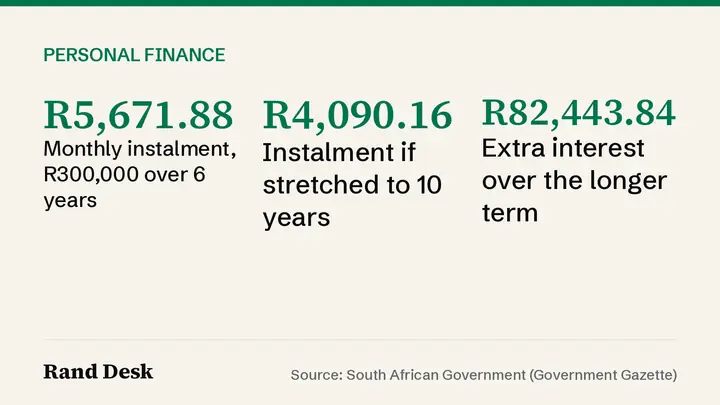
Loan instalments can be cut by stretching the term once a consumer is declared over-indebted. On a R300,000 loan at 10.75%, going from six years to ten drops the instalment from R5,671.88 to R4,090.16 a month.
The route is debt review, set out in sections 86 to 88 of the National Credit Act. The sums here are examples we worked out, and the rules below come from the Act as published in the Government Gazette on 15 March 2006. The Act was amended later, so details may differ today. A registered debt counsellor can confirm them.
How debt review starts
Debt review starts when a consumer applies to a debt counsellor to be declared over-indebted. The counsellor may charge an application fee up to a prescribed amount. The Act bars any fee from a lender for the application. The counsellor must give the consumer proof of receipt and notify every credit provider listed in the application and every registered credit bureau.
The counsellor then assesses whether the consumer appears to be over-indebted. If not, the application is rejected. If the consumer is over-indebted, the counsellor may propose that the Magistrate’s Court re-arrange the debts.
An application cannot cover an agreement where the lender has already started the formal steps to enforce it under section 129.
Source: Our calculation at the prime rate of 10.75% published by the Reserve Bank. The loan size and terms are examples. Chart: Rand Desk
What a court can change
The Act lists four ways to re-arrange a debt. The court can extend the term and reduce each payment, postpone payment dates for a set period, do both, or recalculate the debt where the lender broke the Act’s rules. It can also declare a loan reckless credit.
The counsellor proposes the re-arrangement and the Magistrate’s Court orders it after a hearing, weighing the consumer’s means, prospects and obligations. A consumer whose application the counsellor rejects may, with the court’s leave, apply to the court directly.
The price: no new credit
From the day of application, the consumer “must not incur any further charges under a credit facility or enter into any further credit agreement”, the Act says in section 88. Consolidation agreements are the exception. The ban ends when a rejected application passes its deadline for direct filing, when a court finds no over-indebtedness or rejects the proposal, or when the re-arranged debts are fully paid. A consolidation agreement extends it until that agreement is paid.
Once a lender has notice of the review, section 88(3) restricts it from enforcing its rights through the courts. A lender whose borrower is in default may give notice to end the review at least 60 business days after the application. A court may then order the review to resume.
A worked example
The example is a R300,000 loan at 10.75%, the Reserve Bank’s prime rate this month, with six years to run. The instalment is R5,671.88 and total interest R108,375.36.
If the court stretches it to eight years, the instalment falls to R4,672.17, saving R999.71 a month, and interest rises to R148,528.32. At ten years it is R4,090.16, a saving of R1,581.72 a month, and interest reaches R190,819.20.
A household with R12,000 a month in instalments, one of them this loan, would pay R10,418.28 after the ten-year change. The extra R82,443.84 is the cost of the lower payment. The example assumes prime stays at 10.75% for the whole term.
How we worked it out
Multiply the loan by the monthly rate, which is the annual rate divided by 12, then divide by one minus the monthly rate plus one, raised to minus the number of months. Total interest is the instalment times the months, less the loan. Our explainer on how the repo rate works shows how prime follows it.