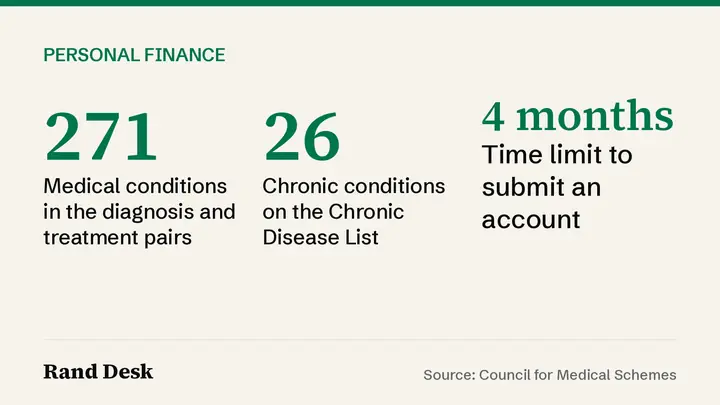
Every medical scheme must cover 271 listed conditions, 26 chronic diseases and any emergency, whatever option you chose, the Council for Medical Schemes says.
The Council, which supervises schemes, calls this set of rights prescribed minimum benefits, or PMBs. They are in the regulations to the Medical Schemes Act, 1998 (Act 131 of 1998).
What counts as a PMB
There are three groups, and the Council lists each one.
The first is any emergency medical condition: a sudden and unexpected health problem that needs immediate treatment or an operation, where delay could mean lasting damage to organs or limbs, or death. If doctors suspect a PMB condition before a diagnosis is confirmed, the Council says the scheme has to approve treatment, and may ask for confirmation within a reasonable time.
The second is the 271 conditions in Annexure A of the regulations. They are written as diagnosis and treatment pairs, each linking a diagnosis to the care it needs, and fall into 15 broad categories. If a scheme and a member disagree on treatment, the protocols used in the public sector apply.
The third is the Chronic Disease List, with 26 conditions. They include asthma, diabetes types 1 and 2, epilepsy, hypertension, glaucoma, rheumatoid arthritis and multiple sclerosis. For these the scheme covers the medicine, and also the doctor’s consultations and tests linked to the condition. The Council says treatment may not be inferior to the algorithms published in the Government Gazette.
The rules that matter when you claim
Diagnosis decides, not the cause. The Council says a doctor deciding whether something is a PMB looks only at the symptoms, not at how the injury or illness was contracted.
That is why scheme exclusions do not apply. The Council gives its own example: if you contract septicaemia after cosmetic surgery, the scheme must cover the septicaemia, because it is a PMB, while the cosmetic surgery stays excluded.
Limits do not run out either. The Council says that even when a member’s benefits for the year are used up, the scheme must still pay for treatment of PMB conditions. Treatment in a state facility is covered too.
Designated service providers and co-payments
Schemes choose designated service providers, or DSPs: the doctors, pharmacists and hospitals they send members to first for PMB care. The Council describes two ways this works.
If the scheme insists on a DSP from the day of diagnosis, it covers the cost in full, provided treatment follows its protocols and formulary, which is its list of approved medicines. If your option lets you choose your own doctor, the scheme may charge a co-payment set out in its registered rules. The Council says this could be a percentage of the bill or the gap between the DSP’s tariff and what your provider charged.
Three exceptions protect you. If there is no DSP within a reasonable distance of your home or work, you may use any provider and the scheme must pay. In an emergency or after an accident you can go to the nearest facility, and the scheme must cover it. And if a DSP cannot treat you or makes you wait unreasonably long, the scheme remains liable for the full cost at another provider.
The diagnosis code on your account
Accounts from providers carry an ICD-10 code, the World Health Organisation’s coding system for diagnoses. The Council gives J03.9 for acute tonsillitis and G40.9 for epilepsy as examples. Schemes use the code to decide which benefit pays.
The Council warns that a wrong code can send a PMB claim to the wrong pool, such as your medical savings account, or leave it unpaid once your day-to-day limits are used. It asks members to make sure the doctor submits a complete account with the correct code, that accounts reach the scheme within four months and that the scheme pays within 30 days of receiving the claim. Schemes may not share your codes with anyone, including your employer.
Where to go from here
The Council’s full PMB list, with ICD-10 codes, can be downloaded from its website, and it publishes the chronic disease algorithms. For how contributions change on 1 January 2027, see the 2027 contribution increases at Discovery and Medihelp, and for the tax side of your contributions, see how the medical scheme fees tax credit works.