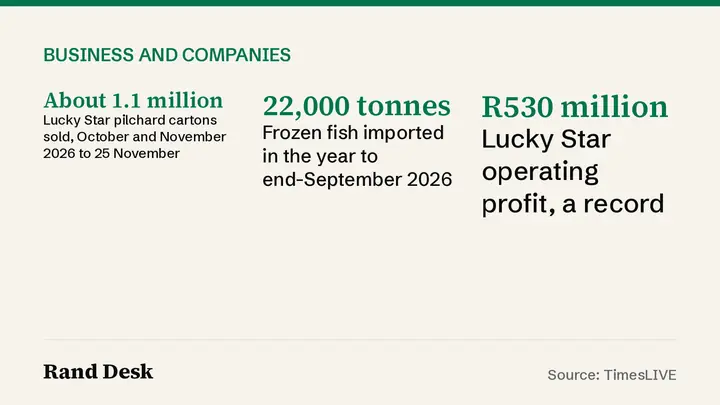
Lucky Star pilchard sales fell by more than half in October and November, to about 1.1 million cartons from 2.3 million, TimesLIVE reported on Thursday.
Chief executive Neville Brink said the fall came from a lack of stock, not weaker demand, TimesLIVE reported. Oceana said a worldwide shortage of frozen fish suitable for canning held back production.
What the results show
For the year to end-September 2026, Oceana’s revenue fell 4.2% to R9.6 billion, according to EWN’s report of the results. Operating profit rose 20.8% to R1.51 billion, and headline earnings rose 50.5% to R1.02 billion from R677 million.
Oceana declared a final dividend of 320c a share. With the interim payment, the total for the year is 430c, up from 285c, EWN reported.
Lucky Star itself made a record operating profit of R530 million, up 13.2%, TimesLIVE reported. TimesLIVE gave two reasons: cheaper stock from the year before and lower distribution costs. The biggest contributor to group earnings was elsewhere: the US fishmeal and fish oil arm, Daybrook, lifted operating profit 69% in dollar terms to US$51 million, TimesLIVE reported. Poor catches left its African fishmeal and fish oil operations with an operating loss of R175 million.
Source: Oceana, as reported by TimesLIVE on 26 November 2026. Chart: Rand Desk
Why the cans ran short
Brink told EWN that “80% of the product that we put in the can doesn’t come from South Africa”. He said the rest is caught elsewhere in the world or bought in as frozen product.
In recent years Oceana bought 50,000 to 100,000 tonnes of frozen pilchards in the northwestern Pacific. None was available to it there this year, according to TimesLIVE, so imports of frozen fish came to only 22,000 tonnes and stocks were low going into the new financial year. TimesLIVE added that a virus has caused die-offs of pilchards off South Africa and Namibia, and that the full effect on supply is still unclear.
What Oceana is doing
To fill the gap, Oceana has contracted a Moroccan cannery and secured more than 7,000 tonnes of herring, part of which is being canned in China, according to TimesLIVE. The herring cans will carry sauces much like the ones on the pilchard range.
Oceana has also made a vessel available to the government for a 45-day survey of fish stocks ahead of next year’s quota allocations.
Brink told EWN it will take a couple of months to replenish Lucky Star stock. Food inflation is a worry for the buyers of canned fish: our report on October’s inflation figures covers the wider picture, and Tiger Brands’ results show how another food maker is dealing with costs.
Oceana is also looking beyond fish. Volumes in canned meat and chicken grew 51%, so capacity there will be expanded in 2027, TimesLIVE reported. It is also weighing its own noodle factory, and Lucky Star put spices on shelves in October.
The next signal on supply is the first half of Oceana’s 2027 financial year, which ends in March 2027, and the arrival of canned herring in shops early next year.