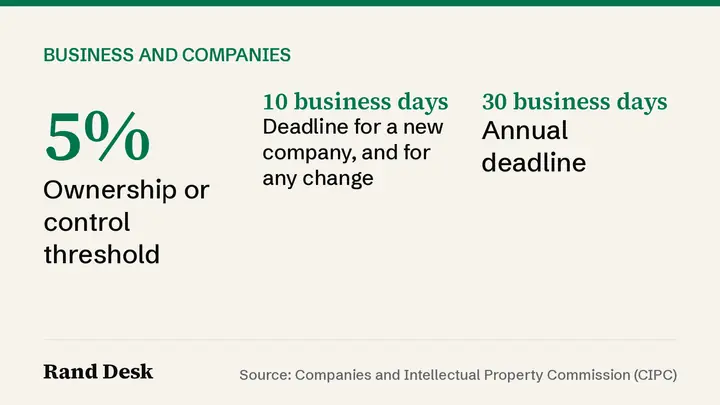
Every company and close corporation must tell the Companies and Intellectual Property Commission (CIPC) who owns or controls it, within 10 business days of registering and then once a year. The CIPC blocks an annual return that has no declaration.
Who counts as a beneficial owner
For the CIPC, a beneficial owner is always a person, not another company: the human being at the end of the chain who owns the business or runs it in practice. Control can come from shares, votes, the power to hire and fire directors, a stack of holding companies, or simply real sway over management. In its Notice 36 of 2026, the CIPC says the threshold is 5% ownership or control.
Every entity on the CIPC’s register has to comply, co-operatives excepted, its beneficial ownership page says. It stems from the 2022 General Laws amendment on money laundering and terrorism financing (Act 22 of 2022), passed after South Africa was placed on the Financial Action Task Force’s “increased monitoring” list, commonly called greylisting.
When to file
A new entity files within 10 business days of incorporation. Any change to the information must also be filed within 10 business days. Then comes a yearly filing, due within 30 business days of the entity’s anniversary, whether or not anything changed. It goes in alongside the annual return and the securities or beneficial interest register.
The July 2025 reminder told older entities that had never filed to catch up for 2023 and 2024, and to file again for 2025 on their anniversary.
The annual return hard stop
From 1 July 2024 the CIPC’s system blocks an annual return from being completed when the declaration is missing. A late return then attracts penalty fees, and the CIPC says deregistration can follow. The CIPC also says on its site that two years of unfiled returns put a company into the deregistration process. Our explainer on annual return fees sets out what the return itself costs.
What the CIPC can do
The reminder the CIPC issued in July 2025 lists the possible consequences: a compliance notice, a worse compliance status on the company’s disclosure certificate, referral to the National Prosecuting Authority, a court-sanctioned administrative fine and eventually deregistration. The notices we read do not give a rand amount for the fine.
Failing to meet the filing and record-keeping requirements in section 24 of the Companies Act is an offence, the CIPC says. Giving false or misleading information is a separate offence under section 214, and the CIPC says it can lead to criminal prosecution.
Inspections
Inspections happen on site and online. Two inspectors at least attend, each showing a section 209 certificate, and they ask to see what was filed, the registers, the shareholding structure, the list of directors and papers that identify the owners.
What this means for a small business
A company held through another company has to trace the chain to the individuals behind it, and the CIPC’s notice list includes an added function on the declaration service for complex structures (Customer Notice 61 of 2024). The next step for any entity is to find its anniversary date, because the declaration is due within 30 business days after it.