Businesses must register for VAT once their taxable sales pass R2.3 million, the South African Revenue Service (SARS) says. Registration became optional from R120,000 a year on 1 April 2026.
SARS’s Budget 2026 questions and answers say the compulsory line rose from R1 million and the voluntary line from R50,000. The Finance Minister announced the change in the Budget on 25 February 2026. SARS said in its questions and answers that the amending legislation had not yet been promulgated, but it applies the new thresholds to registrations since 1 April.
The compulsory line
SARS says a business must register when its taxable sales go past R2.3 million over a 12-month stretch that has not been broken. Taxable sales include goods and services charged at the standard 15% rate and those charged at the zero rate. SARS’s VAT questions and answers say the activity must be an ongoing business, so a one-off private sale does not count.
SARS gives an example: a business that exceeded R191,667 of taxable sales a month, and has no reason to expect that to change, is likely to stay liable to register. That figure is R2.3 million divided by 12.
The voluntary band
Between R120,000 and R2.3 million a year, a business may register but does not have to. SARS says the gains are input tax claims on some business costs, better cash flow and a more credible standing with customers.
Before 1 April 2026From 1 April 2026
Source: SARS, Budget 2026 frequently asked questions. Chart: Rand Desk
The lower line works out to about R10,000 a month. SARS says that a voluntarily registered vendor whose taxable sales in the preceding 12 months were below R120,000 will get a notice of intention to cancel, with a right to object, once the legislation is promulgated. Cancellation is not automatic.
A R1.2 million sole trader
Picture a sole trader with R1.2 million of sales a year, about R100,000 a month, before VAT. Under the old rules that trader sat above the R1 million line and had to register. Under the current thresholds the trader is in the voluntary band.
If registered, the trader charges 15% on top of prices that exclude VAT. A R1,000 service becomes R1,150. Over the year that is R180,000 of output VAT on R1.2 million of sales, which the trader pays to SARS after deducting the VAT paid on business expenses. A customer who is not a VAT vendor pays the extra R180,000, or the trader cuts prices to keep them. These are our examples, not SARS figures or averages.
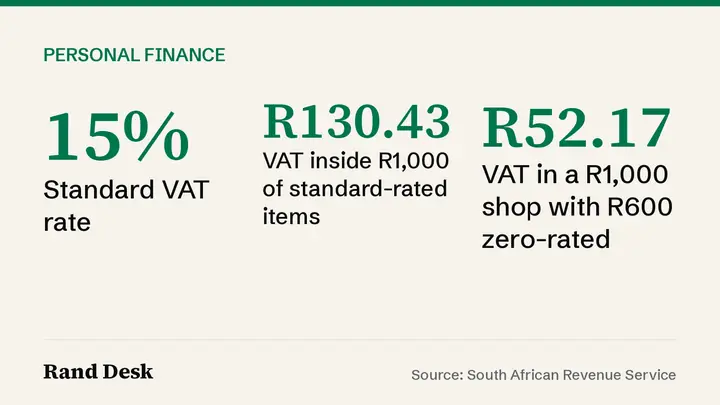
A registered trader below R2.3 million may also apply to deregister. SARS says to weigh the deemed exit VAT, which is VAT owed on goods and rights still held when registration ends, customers’ preference for VAT vendors and the loss of input tax claims. Our explainer on how VAT and zero-rated foods work covers what is charged at 15% and what is not, and what is in R1,000 at 15% VAT shows the sum from the shopper’s side.
How we worked it out
Divide your taxable sales for the last 12 months by 12 to compare with the monthly lines of R10,000 and R191,667. To see the VAT, multiply your sales excluding VAT by 0.15. Registration happens through SARS, which also publishes the VAT101 form. The next step to watch is the promulgation of the amending legislation, after which SARS says it will notify vendors below R120,000.