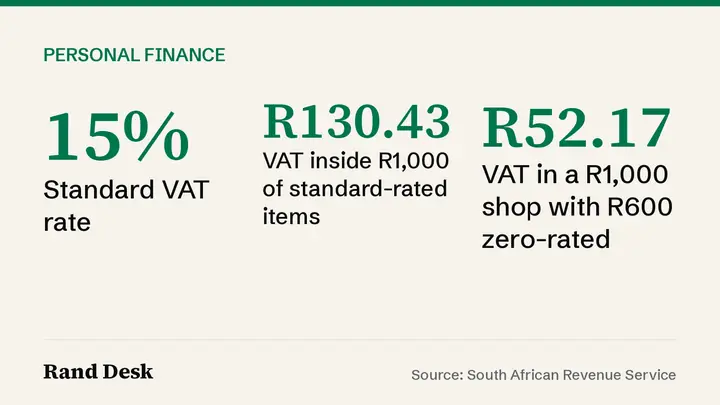
Of every R1,000 spent on standard-rated items, R130.43 is VAT at 15%, and one division finds it.
SARS’s guide for vendors says prices charged, advertised or quoted by a vendor include VAT, at 15% for standard-rated goods. The VAT is already inside the shelf price.
How to take VAT out of a shelf price
SARS’s guide gives the tax fraction as 15/115. The price before VAT is the shelf price divided by 1.15, which is the same sum.
For a standard-rated item at R1,000, the price before VAT is R869.57 and the VAT is R130.43. For R100 the VAT is R13.04. A shortcut gives the same answer: multiply the shelf price by 15 and divide by 115.
Which foods carry no VAT
SARS’s VAT 404 guide for vendors lists basic foodstuffs that are zero-rated, which means VAT is charged at 0%. They include brown bread, brown bread flour, dried mealies and mealie rice, samp, hens’ eggs, fresh vegetables and fruit, dried beans, lentils, maize meal, rice, tinned pilchards, vegetable cooking oil (olive oil excluded) and milk, cultured milk and milk powder.
Source: Our calculation from the SARS standard rate of 15%. Chart: Rand Desk
The guide adds that the item descriptions in the law carry exclusions and conditions, and that the way a product is supplied, packaged or made can keep the zero rate from applying. Our earlier explainer on VAT and zero-rated foods covers the zero rate in more detail.
A R1,000 shop, worked
Consider a shop of R1,000 in which R600 went on zero-rated foods such as rice, eggs and milk and R400 on other standard-rated items. This is an example, not an average household.
The zero-rated R600 carries no VAT. The R400 carries R52.17, and the price of those items before VAT is R347.83. The whole shop therefore holds R52.17 of VAT, and the price before VAT is R947.83.
Had the whole R1,000 been standard-rated, the VAT would have been R130.43. The zero rate lowers the VAT in this example by R78.26.
What this means for South Africa
Shoppers pay VAT inside every standard-rated price, so the zero rate on basic foods lowers the VAT in a household’s weekly shop by R78.26 per R1,000 in this example. The rate has applied at 15% since before this year, and the rule for stripping VAT out of a price is unchanged.
How we worked it out
For any VAT-inclusive price, VAT is price x 15 / 115. It applies to the standard-rated part of a till slip only, because zero-rated items carry no VAT. SARS’s guide says a vendor pays over its output tax less the input tax it paid its suppliers.
For small businesses, SARS says the 2026 Budget Speech raised the compulsory threshold from R1 million to R2.3 million of taxable supplies, and the voluntary one from R50,000 to R120,000, from 1 April 2026.