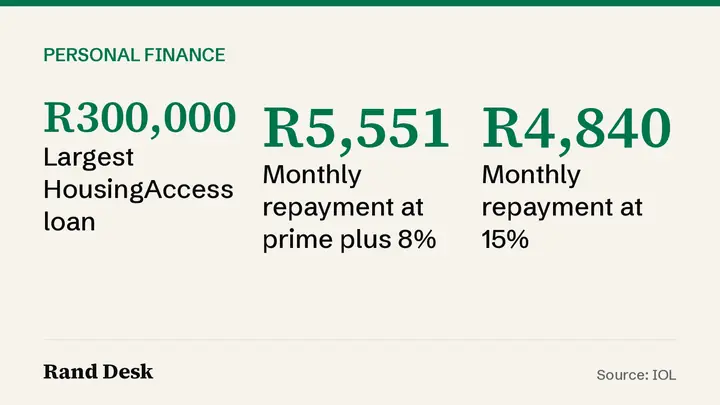
Standard Bank launched a pilot this week called HousingAccess, which offers loans of up to R300,000 for home building and repairs to owners who hold no title deed.
IOL reported that the loans run for up to 10 years and are unsecured, so the house is not pledged as security. The bank still checks that the applicant has the right to the home. The loans are meant for work such as adding a room, repairing a roof or finishing a half-built house, and the bank said they can also fund solar or water systems, according to Moneyweb’s report, which The Citizen carried.
Standard Bank estimates that homes without title deeds in South Africa are worth about R5.38 trillion. Many of them are in townships and rural areas, where families hold recognised ownership or occupation rights without any deed a bank would accept.
Who qualifies
The first phase is open only to Standard Bank customers who earn a formal salary, hold a transactional account with the bank and have at least six months of banking history. The bank said the pilot will test demand and how it assesses affordability.
Funeka Montjane runs the bank’s personal and private banking arm. According to Moneyweb, she said that a missing title deed “shouldn’t be the end of the conversation”. She said the bank weighs a household’s income and verifies ownership rights before it lends.
Source: Rand Desk calculation; rates from Moneyweb's report and the Reserve Bank's prime rate. Chart: Rand Desk
What it costs
Moneyweb reported that borrowers who qualify should expect a rate of as much as 8% over prime, which we read as 8 percentage points. With prime at 10.75%, that is 18.75%. Moneyweb put the usual range for unsecured loans in South Africa at 15% to 28%.
On R300,000 over 10 years, the repayments work out as follows:
- At 15%: R4,840 a month, R280,806 in interest.
- At 18.75%: R5,551 a month, R366,149 in interest.
- At 28%: R7,469 a month, R596,285 in interest.
Standard Bank also offers cashback of up to 20% of the interest paid in each two-year period, for customers who keep every repayment up to date. Moneyweb quoted Motlatsi Mkalala-Cathro, who runs new markets in the bank’s personal and private division, as saying the 24-month cashback may be refined as the pilot teaches the bank more. At 18.75%, the interest in the first 24 months comes to R108,311, so a full cashback would be about R21,662. That is a calculation, not a figure the bank gave.
The larger picture
A home bond is priced lower because the house is the security, and our worked example of a R1.35 million bond at prime shows the gap. Moneyweb reported that the bank will have no recourse to the home here, so a missed payment is the bank’s risk.
Standard Bank said later pilots may take in borrowers whose income is irregular or comes from several sources, and homes beyond the first phase’s reach in rural, township and city areas. It gave no dates. Moneyweb’s report, as carried by The Citizen, mentioned a separate rent-to-own model, Empowa, that targets households with informal incomes.
How a personal loan really costs explains the National Credit Act caps that apply to unsecured credit. The repayments above move with prime, and the Reserve Bank’s Monetary Policy Committee announces its decision on 19 November. What the committee weighs is set out in our preview.