A bonus of two months’ pay loses R7,032 in income tax at R18,000 a month and R65,600 at R80,000, on SARS’s 2026/27 table.
The sums at four salaries
SARS’s table for individuals has seven brackets. The first covers taxable income up to R245,100 a year at 18%, and the 26%, 31%, 36%, 39%, 41% and 45% brackets follow. Every rand of extra income is taxed at the rate of the bracket it lands in, so a bonus costs more in tax the higher the salary.
Our earlier piece on how a one-month bonus is taxed covered three salaries. The sums below use a bonus of two months’ pay and four higher salaries. They add the bonus to the year’s income and compare the tax with and without it. They are examples, not averages.
| Monthly salary | Bonus | Tax on the bonus | Bonus after tax | Share kept |
|---|---|---|---|---|
| R18,000 | R36,000 | R7,032 | R28,968 | 80% |
| R30,000 | R60,000 | R17,445 | R42,555 | 71% |
| R50,000 | R100,000 | R36,126 | R63,874 | 64% |
| R80,000 | R160,000 | R65,600 | R94,400 | 59% |
Why the share climbs
At R18,000 a month, annual pay is R216,000, inside the 18% bracket. The bonus lifts it to R252,000, which crosses R245,100, so most of the bonus is taxed at 18% and R6,900 of it at 26%. The blended rate is 19.5%.
At R30,000 a month, a bonus of R60,000 takes annual pay from R360,000 to R420,000. That crosses the R383,100 mark where the 31% bracket starts, so the blended rate is 29.1%.
Source: Rand Desk calculation on SARS's 2026/27 Rates of Tax for Individuals. Chart: Rand Desk
At R50,000 a month, annual pay of R600,000 is in the 36% bracket, and the bonus pushes R4,200 of it into the 39% bracket. At R80,000 a month, annual pay of R960,000 and R1,120,000 both fall in the 41% bracket, so the bonus is taxed at 41% throughout.
What the payslip shows
A normal month’s PAYE on these salaries is R1,755.00, R4,681.00, R11,075.58 and R22,657.75. In the month the bonus is paid, the same comparison puts PAYE at about R8,787, R22,126, R47,201.58 and R88,257.75.
SARS says employers must deduct PAYE from pay and pay it over to SARS. How a payroll system spreads a bonus across the year can differ from this annual comparison, so your payslip may show slightly different figures.
How we worked it out
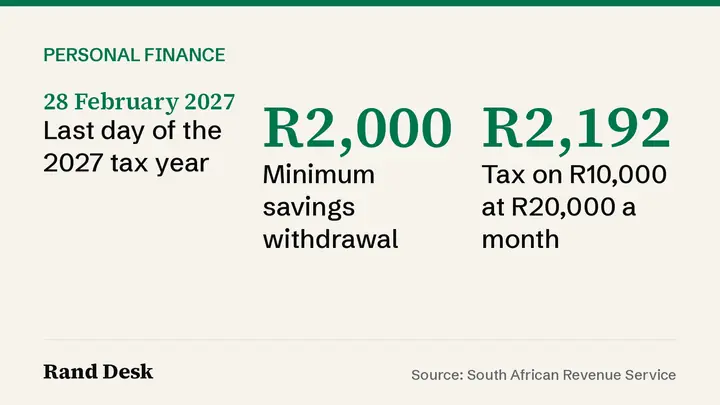
Multiply the monthly salary by 12, work out the tax on the table, then do the same with the bonus added. The gap between the two is the tax on the bonus. For a normal month, take the table’s tax on the year, subtract the R17,820 rebate and divide by 12. You can try your own salary in the take-home pay calculator at randdesk.co.za/tax-calculator.
The table applies to income from 1 March 2026 to 28 February 2027, SARS’s 2027 tax year, so any bonus paid this December is taxed on it.